

Perspectives & Guidance
Trophy Point Coins publishes thoughtful commentary on collecting, valuation, preservation, and market execution. These articles are written to inform decision-making—not to promote transactions—by separating historical meaning from market mechanics.
Whether you are preserving a collection for future generations or evaluating a sale, these perspectives are intended to provide clarity, discipline, and context.
Sales Appraisals: Deciding When and Why to Sell
Sales appraisals exist to answer a single question clearly and without momentum: should this coin be sold at all—and if so, why now?
They are not about execution, venues, or market mechanics. They are about decision clarity.
Within the Perspectives framework, sales appraisals sit upstream of consignment and downstream of long-term stewardship.
What a Sales Appraisal Is (and Is Not)
A Sales Appraisal Is Not:
• A price guide lookup
• A venue recommendation
• A prediction of auction results
• A commitment to sell
A Sales Appraisal Is:
• A decision-focused evaluation
• A test of sell vs. hold vs. redeploy
• A strategic assessment of timing and opportunity cost
• A way to slow down emotionally driven decisions
When a Sales Appraisal Is Appropriate
A sales appraisal is most useful when:
• A coin’s role in a collection has changed
• Capital may be better deployed elsewhere
• Market movement creates pressure to “do something”
• A collection is being refined or upgraded
• Emotional attachment and strategy are in conflict
Sales Appraisals Within the Stewardship Framework
Sales appraisals occupy the decision layer of the stewardship framework.
They prioritize intent, timing, opportunity cost, and collection strategy, while explicitly avoiding execution mechanics.

Why you need a sales appraisal.
For collectors weighing whether to sell, the short video below explains how sales appraisals focus on decision clarity rather than transaction mechanics.
Overview of the sales appraisal approach, centered on disposition decisions and strategic timing.
What Sales Appraisals Optimize For
Sales appraisals are optimized to produce:
• A clear sell / hold / defer recommendation
• Context for why a sale would or would not make sense
• Alignment with broader collecting goals
• Fewer regret-driven decisions
What Sales Appraisals Intentionally Ignore
Sales appraisals intentionally avoid:
• Venue selection
• Hammer price speculation
• Net proceeds modeling
• Execution sequencing
Sales vs. Consignment: The Critical Distinction
A sales appraisal answers the question: should this coin be sold?
A consignment appraisal answers the question: how should it be sold?
Separating these steps prevents decision-making from being distorted by execution mechanics.
Sales appraisals are one expression of the broader stewardship framework outlined in our Perspectives essay on collecting with intent.
Consignment Appraisals: Matching Coins to Markets, Not Price Guides
A consignment appraisal is not simply an estimate of value. It is an analysis of market alignment.
It evaluates venue selection, timing, collector demand, historical performance in comparable sales, and the trade-offs between speed and net proceeds. The goal is not to ask “what is this coin worth,” but “how should this coin be sold.”
The Role of Consignment Appraisals in Market Execution
Consignment appraisals are concerned with execution rather than preservation. The framework below illustrates how this appraisal type emphasizes market alignment, venue selection, and timing over long-term stewardship or documentation.

Consignment appraisal framework emphasizing market alignment, venue selection, and execution strategy rather than price-guide valuation.
For collectors considering sale, the short video below explains how consignment appraisals focus on execution decisions such as venue, timing, and market depth.
What Consignment Appraisals Optimize For—and What They Do Not
Consignment appraisals are explicitly optimized for execution. They are concerned with how a coin will perform in a real market environment, not how it reads in a reference guide or database.
This means prioritizing factors such as venue fit, bidder depth, historical performance of similar material, and the trade-offs between speed, exposure, and net proceeds. A well-executed sale often has less to do with the stated value of a coin and more to do with how and where it is presented.
At the same time, consignment appraisals intentionally de-emphasize considerations that matter in other contexts. They are not designed to preserve long-term narrative, establish heir guidance, or document acquisition intent. Those priorities belong elsewhere in the appraisal spectrum.
This execution-focused approach represents one expression of the broader stewardship framework outlined in our Perspectives essay on collecting with intent.
Legacy Appraisals: Valuing Coins for Stewardship, Not Sale
Not every appraisal is about value in motion. Some are about value in continuity.
Legacy appraisals exist for collectors who are less concerned with what a coin might sell for next year and more concerned with what it will represent decades from now. These appraisals are designed to preserve meaning, intent, and context across generations.
Within the Perspectives framework, legacy appraisals sit firmly at the stewardship end of the spectrum.
They answer a different set of questions than insurance, estate, or consignment work—and they intentionally ignore short-term market noise.
What a Legacy Appraisal Is Designed to Do
A legacy appraisal is not optimized for liquidation, pricing arbitrage, or immediate transaction readiness. Its purpose is to document a collection in a way that allows future custodians—often heirs with limited numismatic background—to understand what matters and why.
This includes historical context, acquisition intent, relative importance within a collection, and guidance on long-term stewardship rather than instructions to sell.
The Role of Legacy Appraisals in Long-Term Stewardship
Legacy appraisals prioritize continuity over transaction readiness. The framework below illustrates how this appraisal type emphasizes meaning, documentation, and guidance rather than short-term market optimization.
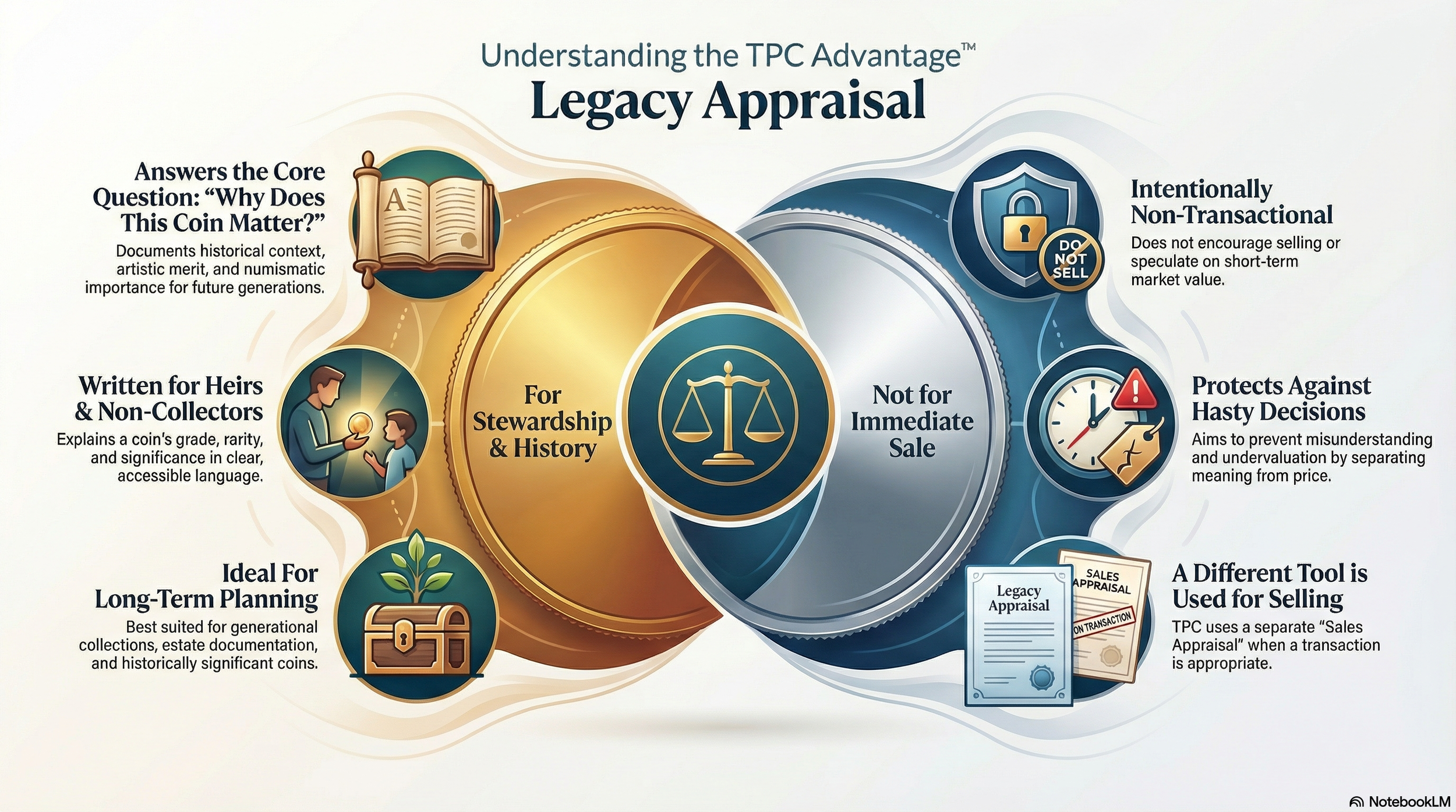
Legacy appraisal framework emphasizing stewardship, documentation, and intergenerational continuity over transaction-driven valuation.
Overview of the legacy appraisal approach, with emphasis on stewardship, documentation, and intergenerational clarity.
Collecting With Intent: A Stewardship Framework for Numismatics
Most families don’t just inherit coins — they inherit silence. Preserving a collection’s meaning requires documentation, context, and stewardship beyond price alone.
Most coins are evaluated on surface attributes: grade, holder, population, recent auction results. Those factors matter—but they are incomplete. Serious collectors eventually discover that the most enduring value in numismatics is created when coins are understood within a broader framework of context, intent, and stewardship.
This perspective is not speculative. It is historical, repeatable, and observable across decades of market cycles.
Beyond Condition: Why Context Matters
A coin does not exist in isolation. It is a product of its time, its minting purpose, its distribution, and its survival. Two coins with identical grades can have materially different long-term relevance depending on:
Original issue intent (circulation, presentation, commemoration)
Survival profile and attrition
Collector demand stability across generations
Institutional and registry recognition over time
Ignoring these factors often leads to short-term decisions that underperform over the long arc of collecting.
A Stewardship-Based View of Numismatics
At its core, stewardship means treating a coin not merely as an object, but as an artifact with responsibility attached to its care, documentation, and placement.
This approach reframes collecting around three questions:
Why was this coin created?
Why has it survived?
Why should it continue to matter?
Coins that answer all three convincingly tend to exhibit durability—culturally, historically, and financially.
The framework below summarizes how we evaluate coins when viewed through a long-term stewardship lens rather than short-term market noise.

A stewardship-based appraisal framework illustrating how different appraisal questions align with distinct client objectives, from preservation of meaning to optimization of outcomes.
Short explainer expanding on the stewardship framework discussed above.
Provenance Is Not Optional
Provenance is often misunderstood as something reserved for trophy coins. In reality, provenance exists on a spectrum. Documentation, prior collections, original holders, and even narrative continuity all contribute to a coin’s historical footprint.
Over time, markets increasingly reward clarity of origin and story—especially as collections transition across generations.
Market Structure and Durability
Not all demand is created equal. Some demand is cyclical; some is structural.
Durable numismatic demand tends to be driven by:
Institutional participation
Registry competition with depth
Educational reinforcement
Cross-generational collector interest
Coins aligned with these forces behave differently during market corrections and periods of volatility.
Why This Perspective Endures
Collectors come and go. Coins remain.
A stewardship framework does not eliminate risk, nor does it guarantee outcomes. What it does provide is discipline—a way to evaluate decisions that extends beyond the next auction result or price guide update.
This is how collections are built to last.
This is how meaning compounds alongside value.
Future Perspectives essays will explore specific series, case studies, and market moments through this same lens—always prioritizing context over hype, and stewardship over speculation.
This essay is part of the Perspectives series on long-term numismatic stewardship and market structure.